Rubiane Maia

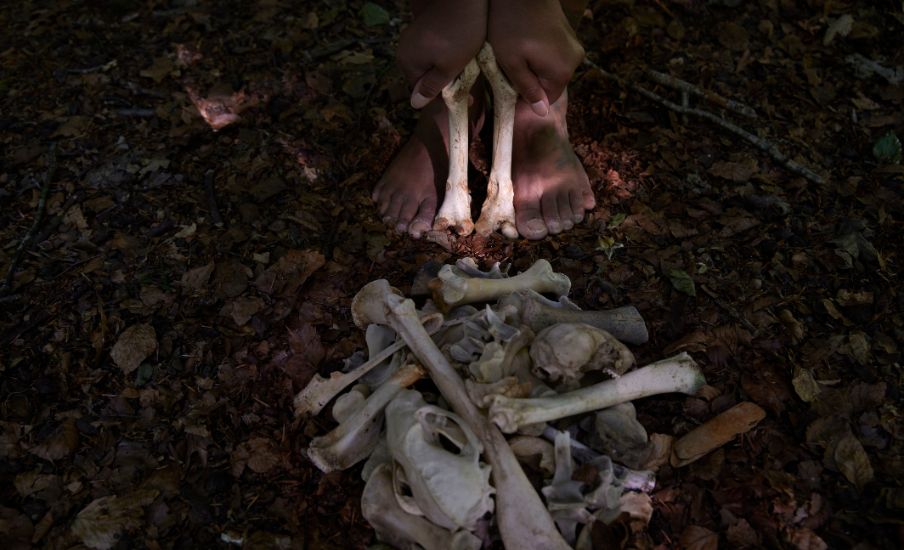
In Search of Darkness is a new artwork by Rubiane Maia, created with five women and non-binary performers based in Folkestone. Together, they explore how we connect to the land, our ancestors and each other through body, voice and spirit.
The piece has two parts: a film installation and a live performance. The film acts as a poetic documentary, following the group’s research and rehearsals. It weaves together movement, sound and conversation to explore how we might listen to the ground beneath our feet – and the stories it holds.
Folkestone’s deep history is central to the work. It draws on the remains of the town’s patron saint, an Anglo-Saxon woman found on Dover Hill, and even fossilised bones of an elephant and a hippopotamus found in The Bayle. These human and more-than-human relics become powerful symbols of memory and transformation.
Spirituality runs throughout the piece. Here, darkness is not empty or frightening – it’s a space for growth. Grief is shown as a powerful force that connects us across time, building strength and meaning.
Through In Search of Darkness, Maia invites us to slow down, listen closely, and feel our connection to the land and to those who came before us.
Read the transcript of In Search of Darkness here.
Photos by Manuel Vason
Rubiane Maia: In Search of Darkness (performance)
Date: Saturday 18 October, 2pm to 5pm
Location: The Loft, 9–17 Sandgate Road, Folkestone, Kent, CT20 1SB, England
FREE, booking required
Join Brazilian and Folkestone based artist Rubiane Maia for In Search of Darkness, a live experimental performance exploring renewal, reflection and quiet change. Taking place indoors at The Loft on Saturday 18 October, this slow, immersive work invites audiences to pause, listen and connect with the earth. No step free access.
About the artist
Rubiane Maia is a Brazilian multidisciplinary artist based in Folkestone. Working across performance, installation, video, writing and photography, her practice explores the body as a site of memory, perception and transformation. Guided by the energies of place, landscape and the more-than-human, she creates works that centre care, interdependence and embodied knowledge.
Often developed through site-responsive research, Maia’s work engages with organic materials, ancestral memory and altered states of perception. Recent projects have drawn on autobiographical texts and transgenerational narratives to address themes of race, gender and belonging.
She has performed and exhibited internationally, including at the 35th São Paulo Biennial (2023), Jerwood Visual Arts, ICA London, and Inhotim Institute. Her two month long durational work The Garden was presented at Terra Comunal – Marina Abramović + MAI, São Paulo (2015), and she has developed research-led projects in high-altitude landscapes across Bolivia, Venezuela and Brazil.
Maia holds a degree in Visual Arts and a Master’s in Institutional Psychology from the Federal University of Espírito Santo.